
Calling the margin
or, The Crash of '29
The hyperinflation experienced by Weimar Germany is legendary in economic history. As Shirer writes in The Rise and Fall of the Third Reich:
The mark, as we have seen, had begun to slide in 1921, when it dropped to 75 to the dollar; the next year if fell to 400 and by the beginning of 1923 to 7,000. Already in the fall of 1922 the German government had asked the Allies to grant a moratorium on reparations payments. This the French government of Poincaré had bluntly refused. When Germany defaulted in deliveries of timber, the hardheaded French Premier, who had been war-time President of France, ordered French troops to occupy the Ruhr.
...
The strangulation of Germany’s economy hastened the final plunge of the mark. On the occupation of the Ruhr in January 1923, it fell to 18,000 to the dollar; by July 1 it had dropped to 160,000; by August 1 to a million. By November ... it took four billion marks to buy a dollar, and thereafter the figures became trillions. German currency had become utterly worthless. Purchasing power of salaries and wages reduced to zero. The life savings of the middle classes and the working classes were wiped out.
But not everyone was upset by this mind-boggling plummet of the German mark. As I described last time, inflation has its winners and losers. Savers, lenders, and those on a fixed income are hurt by inflation as the purchasing power of their currency assets declines. Conversely, however, debtors love inflation, because their nominal obligations become “cheaper” to repay as the real value of the debt falls. There were even winners in the German hyperinflation, and they were influential indeed:
[G]oaded by the big industrialists and landlords, who stood to gain though the masses of the people were financially ruined, the government deliberately let the mark tumble in order to free the State of its public debts, to escape from paying reparations and to sabotage the French in the Ruhr. Moreover, the destruction of the currency enabled German heavy industry to wipe out its indebtedness by refunding its obligations in worthless marks. The General Staff, disguised as the “Truppenamt” (Office of Troops) to evade the peace treaty which supposedly had outlawed it, took notice that the fall of the mark wiped out the war debts and thus left Germany financially unencumbered for a new war.
Seigniorage

Last time, we saw that in the 1920s, the Federal Reserve adhered to a long-criticized economic theory called the real bills doctrine, which held that the Fed could constrain inflation by linking the expansion of the money supply to so-called “real bills,“ meaning short-term credit instruments for transactions involving goods and services. The theory beh…
But although rendering the mark worthless freed the German government and industry of their obligations owed in German currency, setting the stage for secret rearmament, Germany’s war reparations, imposed in the Versailles Treaty by the victorious Allies, who blamed Germany for starting the Great War, were not so easily discharged. The Allied nations were naturally disinclined to be paid in money that was literally not worth the paper it was printed on. They wanted francs, pounds, and dollars.
The European Allies no doubt especially wanted their reparations payments in dollars because they in turn owed the U.S., which had fronted them substantial sums to prosecute the war. But if anything, the decline in the purchasing power of German currency drove that country further into the hole on the reparations front, because to pay them it needed to exchange its totally worthless marks for foreign currency. David Kennedy describes this “surreal financial merry-go-round” in Freedom From Fear:
[The United States] had emerged from the World War in the unaccustomed position of a leading international creditor. The U.S. Treasury had loaned money to the Allied governments in wartime, and private American bankers had loaned significant sums to Germany in the 1920s. The Germans relied on the continuing infusion of private American loans to make reparations payments to the British and the French, who in turn applied those sums to their own bills at the American treasury.
Thus, its seemed that entire conundrum could be solved if the United States would just take it easy on its erst-while brothers-in-arms, Britain and France. But “tightfisted Republican Administrations of the 1920s had refused to admit any connection between German reparations and the debts owed by the Allied governments to the U.S. Treasury.” Debt forgiveness of war-weary Europe was a political non-starter on this side of the pond because Americans widely regarded all such efforts as “ploys to shift the burdens of the war’s costs from Europeans to Americans.”
Instead, the U.S. garnered two renegotiations extending the terms of the payment terms of reparations, in the Dawes Plan (1924) and the Young Plan (1929). Andrew Ross Sorkin writes in his new book 1929 that the Young Plan would have “stretched the reparations payments of about $9 billion over fifty-nine years - an absurdly long duration [that] was the only way a deal could be reached.” German payments were ratcheted down so low that the country would be paying until 1988.
But in 1929 it wasn’t the high-fallutin financial shenanigans of soveriegn nations that would plunge the globe into the greatest economic crisis in world history. Instead, the culprits would turn out to be ordinary Americans themselves.
Leverage negotiation
According to Sorkin, the 1920s “more than any other period in our country’s history, saw the birth of the modern consumer economy[.]” Rapid urbanization created “markets for astonishing new conveniences and goods” such as “cars, radios, and dishwashers, products that nobody knew they needed but that made life so much easier and more enjoyable.” But, he says, “the greatest product, the one that made all the others possible, was credit. Buy now, pay later. It was a kind of magic.”
In this era, companies like General Motors and Sears, Roebuck & Co. “struck a blow against the American taboo of taking out personal loans” by offering cars, expensive appliances, and eventually everyday consumer goods on installment plans. In this era “Americans no longer had to save for goods they wanted” and “[b]orrowing became a habit.”
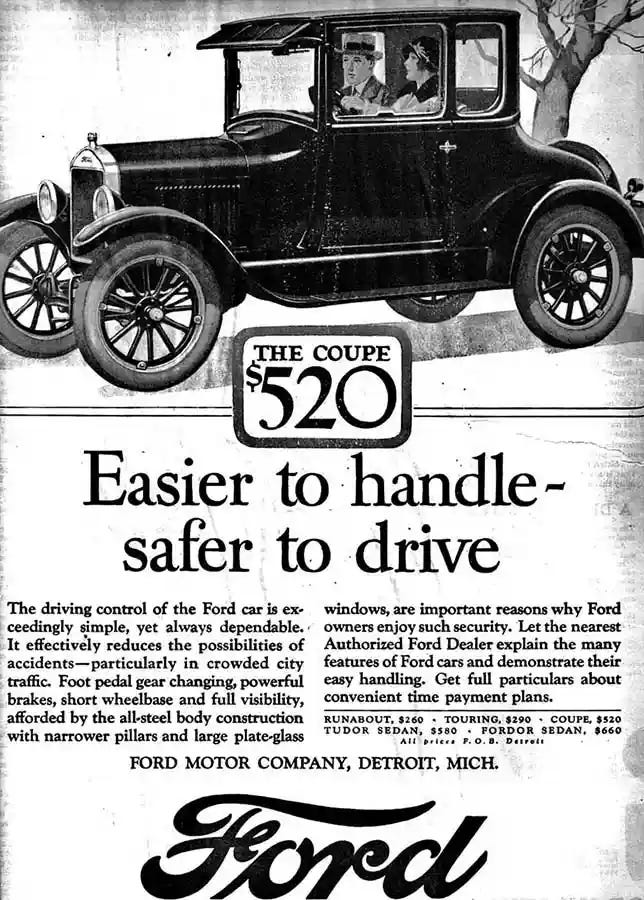
Eggert agrees that the “consumer debt of the United States increased from a trickle to a flood, with the consumer installment purchase industry growing dramatically between 1900 and 1918, and the amount of consumer debt more than doubling during the 1920s alone.” He says that “[s]ome form of installment credit was used in the purchase of most durable goods by 1930, as the automobile manufacturing industry developed the use of credit as a mass-marketing technique for the cars it produced, and many of the automobile companies established their own financing subsidiaries.”
And “[w]ith this growth in consumer debt came an equally dramatic increase in the use of negotiable instruments to embody those debts.” These negotiable instruments were paired with security agreements that put a lien on the product sold. Thus, if a consumer failed to make the payments, the creditor could come and repossess the item to satisfy the debt. At the same time though, because the debt instrument was “negotiable,” it could be freely transferred from the original lender to an infinite series of third parties who then stepped into the shoes of the original creditor.
Companies quickly sprung up, some specializing in the issuance of negotiable instruments to fund consumer installment purchases, and others whose whole business consisted of buying up those bills. The sophisticated issuers of these installment contracts could easily take advantage of unwary consumers by using sharp negotiations, impenetrable legalese, and sales pressure tactics to lock them into repayment terms they couldn’t possibly make. But consumers lost nearly all legal defenses to these deceptive practices when the debt instrument was subsequently “indorsed” over the a third-party company specializing in the purchasing of consumer debt, as I have described.
Fat Stacks: An Origin Story

Over the last few posts, I have been interested the early history of American monetary policy, a supremely obscure topic, to be sure. Last time, I asked, what’s the deal with money, anyway?
But in the 1920s, a real reckoning with the unconscionability of consumer installment purchase arrangements lay far in the future (and perhaps hasn’t happened yet). Meanwhile, with consumer debt financing sweeping the nation, the financial services industry was eager to get in on the game by issuing what were called “broker’s call loans” to ordinary people, as Kennedy describes:
Call loans enabled purchasers to buy stocks on margin, leveraging a cash payment (sometimes as little as 10 percent, but more typically 45 or 50 percent of the stock’s price) with a loan secured by the value of the stock purchased. The lender could theoretically “call” for repayment if the stock price dropped by an amount equal to its collateral value. Though some of the larger brokerage houses shunned the call-loan device, most made profligate use of it. The practice became so popular that brokers at the height of the boom could charge prodigious interest rates on their stock-secured loans to customers.
Sorkin tells how a major proponent of marketing call loans to everyday consumers was Charles Edwin Mitchell, Chairman of National City Bank. He writes that “[b]uying on margin was not a new phenomenon” but “’[w]hat was different was that it had recently migrated beyond the professional class and into the mainstream, thanks in large part to Mitchell,” who had “aggressively extended credit - both to individual investors and to brokerage firms, making it far easier for them to offer margin accounts to their customers.”

And why shouldn’t consumers be able to benefit from the rapidly growing American economy? Why should only a select cabal of Wall Street insiders have the opportunity to grow fabulously rich from stock trading? After all, Americans were “already using credit to buy cars, refrigerators, and radios ... Mitchell and National City Bank were making it possible for ordinary Americans to invest in the future.”
As a result of the efforts of Mitchell and other call lenders, outstanding call loans grew from $1 billion at the beginning of the 1920s to nearly $6 billion on the eve of October 1929, “inflating the market into what many now feared was a dangerous bubble.” Even as the underlying economy was slumping, an “orgy of mad speculation” (as Herbert Hoover called it) was driving the stock market higher and higher. Kennedy writes that stock prices were “catapulted into a phantasmagorical realm where the laws of rational economic behavior went unpromulgated, and prices had no discernable relation to values.”
Among those most concerned, and uniquely in a position to do something about it, was the Federal Reserve. On the one hand, it was arguably the easy money policy of the Fed itself during the 1920s that had fueled the bubble by providing the liquidity for banks to deploy margin lending at scale. But the Fed in this era sharply distinguished between loans based on productive economic activity (which it designated “real bills”) and what it considered non-productive speculative lending, such as broker’s call loans.
Real bills

A recurring theme in my recent excavations of America’s financial history has been the perpetual banking panics that have incessantly gripped the American economic system. These periodic crises appear frequently to mark the turning point in the business cycle, whereby a rapidly expanding economy overshoots its own capacity, only to realize abruptly and …
Yet the Fed failed to tighten credit in the run up to the summer of 1929, for fear of the collateral damage to “real” business activity and due to push back from captains of finance like Mitchell (who actually sat on the board of the New York Fed). But while “[m]uch blame has been leveled at a feckless Federal Reserve System for failing to tighten credit as the speculative fires spread” and arguably it was the “easy-money policies of 1927 [that] helped to kindle the blaze, the fact is that by late 1928 it had probably burned beyond controlling by orthodox financial measures.” When the Fed belatedly raised the discount rate to 6% in the late summer of 1929, it was far too little, too late.
Fell on black days
The “first rumblings of distress were heard in September 1929, when stock prices at the New York Stock Exchange broke unexpectedly, though they swiftly recovered.” On October 19, a Saturday, there was another shocking market-break, “prompting brokers to issue margin calls to customers,” Sorkin writes:
Many bankers and brokers had already raised their margin reguirements to 50 percent, up from the 10 percent that many of their regular clients were accustomed to. Investors who were short on cash found themselves in a very uncomfortable spot, watching helplessly as brokers sold off their positions to recover debts. This set a self-perpetuating cycle in motion. As brokers liquidated accounts, selling shares for whatever they could get, their actions drove stock prices even lower, triggering yet more margin calls, and yet more liquidation. In the matter of hours, $1 billion in equity vanished.
Wednesday, October 23 was another day of “panic selling [that] hit blue-chip stocks” in established companies, which were supposed to be reliable and relatively impervious to speculatory inflation. More than six million shares were exchanged, destroying $4 billion in value. Selling was so intense that the stock tickers that were supposed to report stock prices in real time fell hours behind the trading.
On October 24th, thousands gathered on Wall Street outside the Stock Exchange to witness their fates. The police “wielding clubs piled from the paggy wagons,” but they were totally insufficient to control the throngs. On “Black Thursday,” nearly 13 million shares were traded in a single day, breaking all previous records and wiping out around $9 billion in the process.
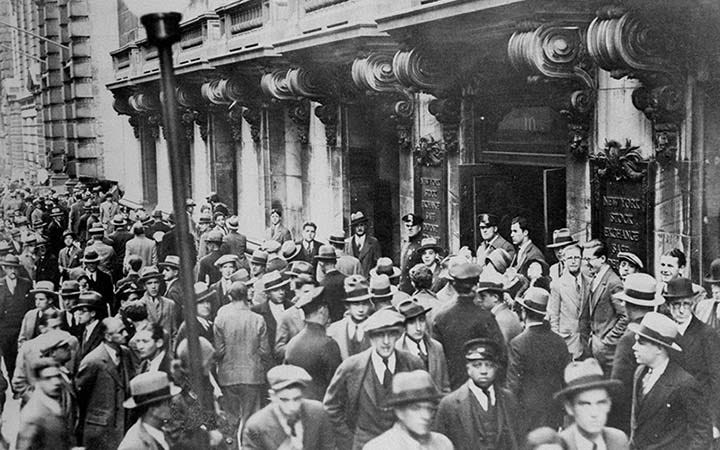
On “Black Monday,” the slide continued unabated as the margin calls and fire-sales of even blue chips continued to sky-rocket. The Dow Jones Industrial Average experienced a record loss of 12.82%. There were winners though, even in that carnage. “Short” sellers bet against the market and reaped rewards when the market fell.1
But, if Thursday and Monday were black, “what could be said of the following Tuesday, October 29, when 16,410,000 shares were bought an sold - a record that stood for thirty-nine years?” Kennedy wonders.
“Black Tuesday” pulled down a cloak of gloom over Wall Street. Traders abandoned all hope that the frightful shake-out could somehow be averted. For two more gastly weeks stock prices continued to plummet freely down the same celestial voids through which they had recently and so wonderously ascended.
The shocking events of late October 1929 revealed the double-edged sword of debt-financed speculation. The “multiplication of values that buying on margin made possible in a rising market worked with impartial and fearful symmetry when values were on the way down.” Even a minor fall in prices could result in margin calls, compelling already leveraged investors to either pony up the call or watch their investments sold to satisfy the debt. “Millions of such sales occuring simultaneously blew the floor out from under many stocks.”
Although the market tried to rally in fits and starts in the months after October, by the spring of 1930, the “air simply leaked out of the balloon, day after day after day,” Sorkin writes. The Crash of 1929 was “not a moment. It was a relentless unraveling.”
The Crash of 1929 has achieved mythological proportions in the history of the twentieth century. “Perhaps the most imperishable misconception portrays the Crash as the cause of the Great Depression that persisted through the decade of the 1930s,” Kennedy says.
The layman can be forgiven for accepting the “intuitive plausibility” of such an account, which places the calamity of 1929 into a neat historical progression “render[ing] understandable and thus tolerable even the most terrifying human experiences.” Most economists, however, have pooh-poohed any direct causal link between the Crash of 1929 and the Great Depression that followed on its heals. Correllation, after all, is not causation.
But, in Sorkin’s opinion, while the “crash may not have caused the larger business depression, [ ] it certainly had a powerful effect.” The obliteration of asset prices dried up credit markets because “[w]hen there’s no collateral that seems reliable, only the foolish lend.” As a result, “[c]redit, the lifeblood of the modern economy, was nowhere to be found.”
Whatever the connection between the Crash of ‘29 and the ensuing Great Depression, the repercussions of these successive disasters were felt well beyond the United States. The effects spread across the globe and especially to the nations of Europe, whose economies were intertwined with America’s. “The results in Germany were soon felt - and disastrously,” Shirer writes:
The cornerstone of German prosperity had been loans from abroad, principally from America, and world trade. When the flow of loans dried up and repayment on the old ones became due the German financial structure was unable to stand the strain. When world trade sagged following the general slump Germany was unable to export enough to pay for essential imports of raw materials and food which she needed. Without exports, German industry could not keep its plants going and its production fell by almost half from 1929 to 1932. Millions were thrown out of work.
And of course, “Hitler had predicted the catastrophe,” even though he had always been “both ignorant of and uninterested in economics.” He was however, “not uninterested in or ignorant of the opportunities which the depression suddenly gave him.” The “suffering of his fellow Germans was not something to waste time sympathizing with, but rather to transform, cold-bloodedly and immediately into political support for his own ambitions. This he proceeded to do in the late summer of 1930.”
Shorting a stock is a form of stock speculation where the profit occurs from a decline in value of the stock, instead of an increase in value. Basically, you borrow a stock, sell it and then buy it back later. If the stock price has gone down, you can pocket the difference.