
Greenbacks
In which Hamilton gets the last laugh
I previously described how in the early modern era the “holder in due course” doctrine made private debt instruments negotiable, so that they circulated as mediums of exchange (paper money). In that way, they could substitute or even supplement the money supply consisting of gold and silver. Paper currency could facilitate commercial activity by ameliorating the scarcity and portability issues of specie.
Fat Stacks: An Origin Story

Over the last few posts, I have been interested the early history of American monetary policy, a supremely obscure topic, to be sure. Last time, I asked, what’s the deal with money, anyway?
Professor White describes in Law in American History Vol. II how this distinct field of “commercial law” emerged from contract law owing to the “importance of credit in the eighteenth- and early nineteenth-century American economy, combined with the recurrent problems in the money supply.” He writes that
many of the major economic ventures in colonial and Revolutionary America were financed through transactions that relied on credit. English and Scottish banks and merchantile firms would issue bills of exchange and promissory notes to American plantation owners and farmers as payment for future crops. The indorsees of bills and notes would use them to purchase goods from England, or would transfer them to other persons as payment for domestic goods and services.
This system was “heavily dependent on the reputations of the parties participating in it” and “’dishonoring’ a bill or note (declining to pay it) was regarded as a blemish on one’s reputation and could result not only in civil damages but in imprisonment.”
These bills and notes would only serve as currency, however, to the extent that they could be used by third parties to the original transactions. Enter the concept of “negotiability,” which allowed a financial instrument to be indorsed to such a third party, in the same way that you can sign over a check.
At common law, contracts could not be assigned (transferred) and a person could not sue another to enforce a contract unless they were both in “privity,” meaning that both were parties to the original deal. But as a holder in due course, a subsequent indorsee of a negotiable instrument not only could enforce it against the original maker but actually had more rights than the original creditor because, as an innocent third party, she held it free from many defenses that the maker might have asserted against the original creditor.
But holder in due course status also offered opportunities for sharp dealing and even outright shenanigans. Consequently, many state courts in the early nineteenth century harbored a healthy skepticism of the doctrine. Just such holder in due course chicanery supplied the facts of one of the most controversial Supreme Court cases of the era: Swift v. Tyson (1842).1
Tyson was an investor in a shady real estate firm involved in land speculation that was operated by Keith and Norton. Tyson issued a note to the firm to purchase a stake in an unsettled tract located in Maine, which had recently entered the Union as a state in 1820 after being carved out of Massachusetts. The firm claimed to have obtained the parcel from a mysterious “European” real estate speculator. Of course, they had did not own any such tract.
Keith and Norton meanwhile owed Swift, a cashier at a bank in Portland, on another bogus deal and indorsed over Tyson’s note to satisfy Swift, before dipping out. But by the time that Swift went to redeem the note, Tyson had already realized that he’d been had by Keith and Norton and he had no intention of honoring a debt contacted for land that did not exist.
At trial in federal court in New York, the district judge, following New York state law, instructed the jury to decide the case according to the common law of contracts, under which holders in due course were not a thing, rather than under the commercial law of negotiable instruments, which recognized them. Consequently, the jury found for Tyson.
On appeal to the federal circuit court, it was pointed out that under the Judiciary Act of 1789 (which I have previously discussed), the “laws of the several states” supplied the “rules of decisions in the trials at common law in the courts of the United States.” That presumably meant that the district court judge had been right to tell the jury to apply the law of New York (where the court sat), which did not recognize holders in due course.
Riding Circuit

Last time, I wrote that the second Trump Administration's expansive vision of executive power seems to encompass not merely a unitary executive but a unitary government, in which the President of the United States doesn't just take care that the the law be faithfully executed, but also decides what the laws are and adjudicates what they mean. It's inter…
In this era, cases such as Swift that were based on diversity jurisdiction (i.e. parties from different states) could be appealed from the federal circuit court if there was a “certificate of division,” meaning that the two circuit judges disagreed on the outcome of the case. A certificate of division was filed on Swift in 1840, bringing the case to the U.S. Supreme Court two years later.
Reversing the decision below, Justice Joseph Story (who had been the president of a bank and literally wrote the book on the law of negotiable instruments) rejected the parochial application of New York common law, in favor of a “general” commercial law that would facilitate, to “as wide an extent at practicable[,]” the “credit and circulation of negotiable paper.” Without the the holder in due course doctrine, he worried, the “value and circulation of such securities must be essentially diminished.” This was because, if subsequent indorsees would have to litigate the underlying transaction from which the instrument arose, a situation about which they usually had no direct knowledge, they would be disinclined to accept such instruments as payment.
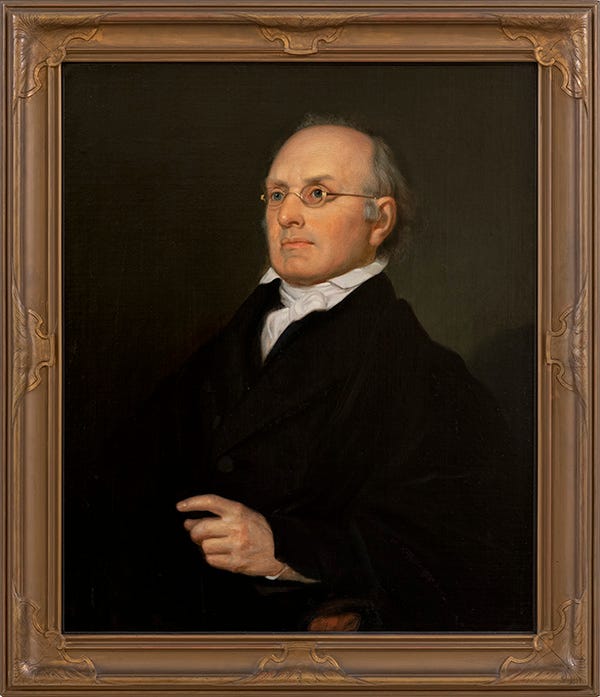
As Professor White observes, “it made sense to have federal courts endorse that conception” because “[n]egotiable paper increasingly crossed state lines, as it had in Swift v. Tyson.” If the federal courts were “bound by the restrictive common law rules of state courts about commerical transactions” it would “seriously retard negotiability.” Nevertheless, “if the justices who decided Swift contemplated the continued growth of bills and notes as a form of currency until they radiated throughout the Union, that prospect did not occur.”
Birth of the fiscal military state
The American Civil War was the nation’s, and probably the world’s, first modern industrial war. It was a titanic conflict that would come to be seen as a dress-rehearsal for the global wars of the twentieth century; the first “total” war. In order to wage this epic struggle, the Union had to spin up, essentially from scratch, not only a modern military but the fiscal resources to finance it.
The federal government had three major tools that it could leverage to fund the war effort: taxation, borrowing, and printing money. Taxation has the benefit of being the least inflationary of the three, but it is paradoxically also the most politically poisonous for the very reason that the other two exact their pound of flesh only elliptically through the regressive indirect tax of inflation.
Prior to that time, antebellum Americans had been some of the lightest taxed people in the world because the national government was small and collected most of its revenues through tariffs. But James McPherson writes in Battle Cry of Freedom, Congress “taxed almost everything but the air northerners breathed” in the Internal Revenue Act of 1862.
Besides raising tariffs rates in the Internal Revenue Act, Congress enacted the first federal income tax in American history. The Act also created the Bureau of Internal Revenue dedicated to the collection of federal taxes.
As I have written, the constitutionality of the federal income tax was uncertain at that time because nobody knew whether income taxes were “direct taxes” under Article I, Section 9, Clause 4. After the war, the Supreme Court would strike down a later income tax law as a direct tax but the Court was decisively repudiated by the American people, when in 1913 we ratified the Sixteen Amendment confirming that income taxes are not subject to apportionment among the states.
Direct taxes and the Sixteenth Amendment

Last term, the Supreme Court was asked in Moore v. U.S. whether the Mandatory Repatriation Tax, a provision of the 2017 Tax Cuts and Jobs Act, was a constitutional application of Congress’s taxing power. The Moores argued that the MRT, which taxed Americans for certain income earned by foreign corporations in which they held stock, was an unapportioned
The war-time income tax, meanwhile, provided a stable revenue stream that supported an expanded capacity to fund indebtedness. As McPherson recounts, Secretary of Treasury Salmon P. Chase (about whom, more below) “pioneered the concept of selling bonds to ordinary people, as well as bankers, in denominations as small as $50 to be paid in monthly installments.”
These bonds were marketed by “patriotic advertising that anticipated the great war-bond drives of the twentieth century.” Although the “policy of financing a democratic war by democratic means got off to a slow start ... the Union ultimately raised two-thirds of its revenues” through war bonds.
At the same time, with the Legal Tender Act of 1862, Congress authorized the issuance $150 million in Treasury notes. These Treasury notes, which were unprecedented in American history because did not bear interest and could not be redeemed for gold, came to be known as “greenbacks” due to their color.
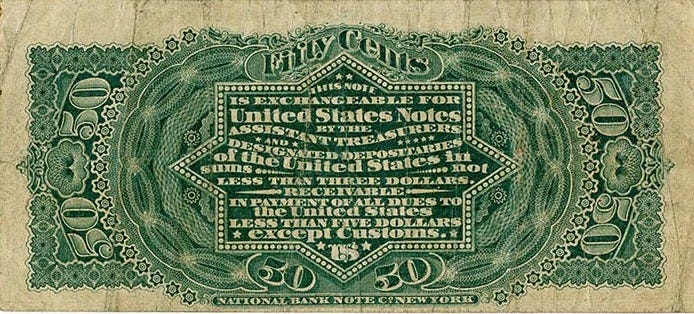
Greenbacks constituted legal tender, meaning that they were “receivable for all debts public or private except interest on government bonds and customs duties.” Never before had the law required all persons to accept Treasury notes in payments for debts and obligations.
Greenbacks served as the first ever true fungible national currency. As we have seen, prior to this time paper currency consisted of private notes issued by private banks and individuals whose value depended on the idiosyncracies of each individual note. Earlier generations had tried to establish such a national paper currency through the First and Second Banks of the United States, but Andrew Jackson had destroyed the Second BOTUS in his Bank War, devolving the nation’s monetary and banking systems to the several states.
The bank war

On April 10, 1816, President James Madison signed a bill chartering the second Bank of the United States. It was a particularly bitter pill to swallow for the man who had spearheaded the Jeffersonians' rhetorical attack against the first Bank of the United States in the U.S. House of Representatives in 1791.
The hot mess of circulating state notes made doing business across state lines a major headache because notes from one state were honored at a discount, if at all, in sister states. Greenbacks, on the other hand, were intended to replace the plethora of diverse state paper with a stable and uniform monetary system.
To shore up their new national currency, Congress followed up with national banking legislation, which established a tax on state bank notes to discourage their competition with greenbacks and created a Comptroller of the Currency with authority to charter federal banks and regulate them. These were not semi-public central banks like the prior First and Second Banks of the United States or the later Federal Reserve System. Instead they were essentially private, for-profit enterprises. They were, of course, heavily incentivized to purchase war bonds.
Federal banking legislation also authorized the Comptroller to establish capital and reserve requirements that stipulated the amount of actual specie, as a percentage of their outstanding obligations, that banks needed to keep on hand. As we have seen, the fractional reserve system of banking can stimulate economic activity by expanding the monetary supply. But, without externally imposed reserve requirements, banks may have an incentive to spin out more and more debt in relation to their reserves, threatening bank runs that can cascade into a financial crisis.2
The Money Multipliers

In 1791, the United States of America was a decentralized and under-developed economic backwater. But the country’s first Treasury Secretary, Alexander Hamilton, had a plan. He intended to weild the powers of the federal government, newly granted in the recently ratified Constitution, to transform the American economy through what we would today call ec…
The Legal Tender Cases
Among modern proposals to reform the Supreme Court offered by its left-leaning critics, court-packing is one of the most controversial. Packing the Court would involve a future Democratically-held Congress enacting legislation to expand the number of justices and then confirming progressive justices appointed by a politically aligned President until there is a majority on the court to overturn Citizens United, Bruen, Dobbs, and other judicial bete noires of the left. The problem with this approach is that it would surely invite a tit-for-tat when Republicans inevitably regained control of the political branches.
But although court-packing is generally considered beyond the pale today, something like that seems to have been deployed during the Grant Administration to ensure the legality of greenbacks. In a series of three cases that have come to be known as the Legal Tender Cases, the Supreme Court first struck down the Legal Tender Act and then quickly overruled itself after a shake-up in the court’s personnel, including a new member added by legislation increasing the number of justices from eight to nine.
The question was whether Congress had the constitutional authority to establish a paper currency as legal tender. Article I, Sec. 8 authorizes Congress to “coin Money, [and] regulate the Value thereof,” but that seemed to refer to Congress’s recognized authority over gold and silver specie, not paper. To make matters worse, it seemed like forcing someone to accept new paper money for a pre-existing debt might violate the law of contracts.
In Hepburn v. Griswold (1868), a 5-3 majority of the Court struck down the Legal Tender Act. Chief Justice Salmon P. Chase, who had been Secretary of the Treasury when the Act was passed, wrote for the majority that
an act making mere promises to pay dollars a legal tender in payment of debts previously contracted, is not a means appropriate, plainly adapted, really calculated to carry into effect any express power vested in Congress; that such an act is inconsistent with the spirit of the Constitution; and that it is prohibited by the Constitution.
But there was something rotten in the Kingdom of Denmark, because the fifth vote, Justice Robert Grier, who was elderly and ailing, had initially sided with the minority to uphold the law (resulting in a 4-4 tie). When Chief Justice Chase subsequently announced the 5-3 decision, he said that Grier, who had retired in the meantime, had changed his mind and voted to strike down the Act. But if he did, it seems that it was only on the narrower application to preexisting debts and not the larger question of whether Congress had authority to issue paper legal tender at all.
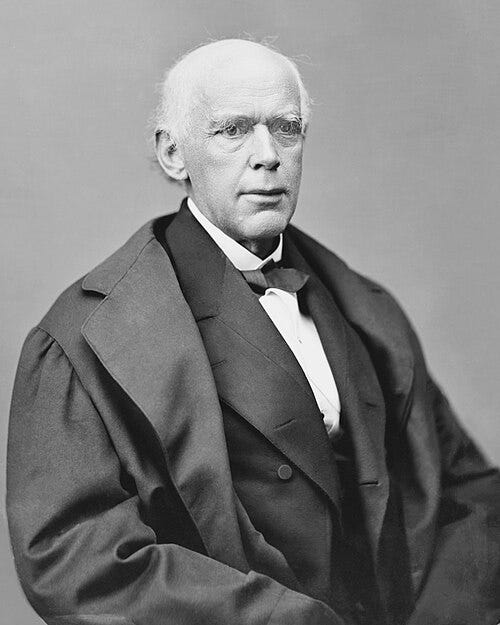
Between the 1869 and 1870 Supreme Court terms, Congress enacted legislation expanding the number of justices from eight to nine. That, plus Grier’s retirement, gave President Grant two seats to fill. He appointed William Strong and Joseph Bradley, and they were quickly confirmed before the 1870 term. The new majority set two cases raising the same issue for reargument: Knox v. Lee and Parker v. Davis.
Justice Strong wrote for the majority upholding the Legal Tender Act, as to both prior and future debts. The law was “necessary and proper” for carrying out Congress’s other enumerated powers, such as its authority to regulate interstate commerce. Indeed, it had been enacted as an essential war measure:
Congress was called upon to devise means for maintaining the army and navy, for securing the large supplies of money needed, and, indeed, for the preservation of the government created by the Constitution. It was at such a time and in such an emergency that the legal tender acts were passed. Now, if it were certain that nothing else would have supplied the absolute necessities of the Treasury, that nothing else would have enabled the government to maintain its armies and navy, that nothing else would have saved the government and the Constitution from destruction, while the legal tender acts would, could anyone be bold enough to assert that Congress transgressed its powers?
Necessary and Proper

Congress is a legislature granted enumerated powers by Article I, Section 8 of the constitution. The constitution’s enumeration of congressional powers means that, unlike most state legislatures, it does not possess a general legislative jurisdiction to regulate for the public health, safety, and welfare. Rather, if Congress is to pass legislation, that…
Professor White concludes that the major legacy of the Legal Tender Cases was that “debts could now be paid off in national banknotes” and “[w]ith the emergence of national bank notes as currency, the need for negotiable commercial paper as a currency form was reduced.” Unlike state notes, greenbacks did not individually fluctuate in value or require the consent of an indorser to be issued.
Federal paper “became the basis of a stable American currency system, one which relied much less on the intricate chain of indorsees and holders of which currency networks at the time of Swift v. Tyson were composed.” Consequently, greenbacks “became the preferred medium for financing commercial transactions after the Civil War” and “[f]rom the Reconstruction years through the 1920s, contract law, rather than commercial law, formed the context of most American economic ventures.” Nonetheless, as I have discussed, the holder in due course doctrine would rise again in the twentieth century.
In many ways, with the end of the Civil War, the American Republic wound back down to its sleep, nineteenth century ways. White writes that “[t]en years after the end of the Civil War few signs of the expanded federal presence associated with it were visible.”
But certain elements endured. As we have seen, federal money was here to stay. So was the new national banking system, which laid the groundwork for the future Federal Reserve Bank. And then there was the income tax.
And more profoundly, the war had served as proof of concept that the federal government could bend the national economy to its will in order to save the country from an existential crisis. That was a bell that could not be unrung.
McPherson writes:
By its legislation to finance the war, emancipate the slaves, and invest public land in future growth, the 37th Congress did more than any other in history to change the course of national life. As one scholar has aptly written, this Congress drafted “the blueprint for modern America.” It also helped shape what historians Charles and Mary Beard labeled the “Second American Revolution” - that process by which “the capitalists, laborers and farmers of the North and West drove from power in the national government the planting aristocracy of the South [...]”
The Jeffersonian dream of an agrarian republic ruled over by an oligarchy of elite gentlemen farmers was not to be. Instead, the United States would be a military-industrial empire, backed by Wall Street. Andrew Jackson may have won the battle by destroying the Second Bank of the United States, but in the end the Jeffersonians lost the war for the future soul of the nation:
[T]he legislation of the 37th Congress that authorized war bonds to be bought with greenbacks and repaid with gold and thereby helped concentrate investment capital, that confiscated southern property and strengthened northern industry by expanding internal markets, protecting those markets with tariffs, and improving access to them with subsidies to transportation, that settled the public domain and improved its cultivation, and rationalized the country’s monetary and credit structure - this legislation did indeed help fashion a future different enough from the past to merit the label of a revolution.
The fiscal military state had been born. Somewhere, the ghost of Alexander Hamilton was laughing.
The fiscal military state

Aside from Marbury v. Madison (1803), which I previously discussed at some length, Chief Justice John Marshall's most famous opinion is McCulloch v. Maryland (1819). As I have described, that case arose out of a controversy involving the second Bank of the United States, a federal bank chartered by Congress in 1816.
Swift is controversial due to its holding that federal courts could disregard the common law of the particular state in which they sat and apply a general federal common law instead. It was overruled in the twentieth century Erie v. Tompkins.